Closed Cell Rate Test – Accredited Determination of Closed Cell Content for Thermal Insulation, Buoyancy and Structural Foams
Our laboratory provides an internationally accredited closed cell rate test service that precisely quantifies the percentage of closed cells in rigid and flexible cellular materials. Every test is performed within our ISO/IEC 17025 accreditation framework, and each report bearing the ILAC mark is unconditionally accepted by the Czech Trade Inspection Authority, customs offices and all notified bodies in the European Union. The closed cell content is the single most important structural parameter governing thermal conductivity, water absorption, compressive strength and buoyancy of foam products. For Czech importers, building product manufacturers and automotive suppliers, independent verification of closed cell rate is essential for CE marking under the Construction Products Regulation, for demonstrating compliance with harmonised European product standards, and for ensuring that insulation boards, pipe sections and flotation devices will perform as declared throughout their service life in the Central European climate.
Product Samples We Regularly Subject to the Closed Cell Rate Test
The gas pycnometer method accommodates a wide variety of cellular materials. The following categories represent the most frequently tested items received from Czech and European clients:
- Expanded and extruded polystyrene foams (EPS and XPS) – thermal insulation boards for floors, walls, flat roofs and foundation slabs
- Rigid polyurethane and polyisocyanurate foams (PUR and PIR) – sandwich panel cores, spray-applied insulation, pipe insulation shells and district heating pipes
- Cellular glass – heavy-duty thermal insulation boards for industrial tanks, cold stores and underground applications
- Polyethylene and polypropylene foams – packaging foams, automotive interior padding, gaskets and expansion joint fillers
- PVC and structural core foams – materials for boat hulls, wind turbine blades and transport vehicle panels
- Elastomeric foams – flexible insulation tubes and sheets for HVAC and refrigeration systems
- Syntactic foams and hollow microsphere composites – buoyancy modules for offshore equipment, subsea vehicles and deep-water floats
- Bio-based and recyclable foams – experimental materials developed for sustainable packaging and building applications
Closed Cell Rate Testing of Rigid Cellular Plastics According to ISO 4590 and ASTM D6226
- Specimen preparation and geometric volume measurement according to ISO 4590 and ASTM D6226: rectangular or cylindrical test specimens are cut from the core of the foam product with a fine-tooth saw or a hot wire, taking care to avoid compression of the cell structure. The exact dimensions – length, width and thickness – are measured with a calibrated digital calliper to calculate the geometric volume Vg of the specimen in cubic centimetres. For materials with a pronounced skin, specimens are taken from both the core and near the surface to assess the uniformity of the closed cell rate throughout the thickness.
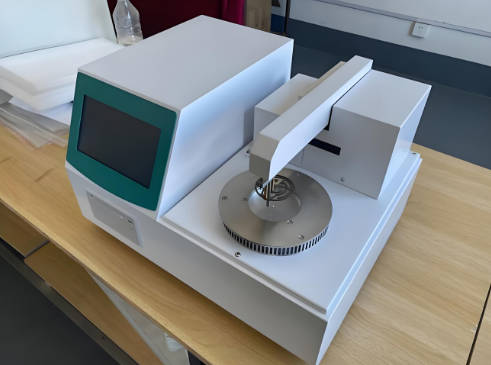
- Air comparison pycnometry for inaccessible volume determination: the specimen is placed in the sample chamber of a gas pycnometer, and the chamber is pressurised with dry, filtered air or nitrogen to a preset pressure. The gas penetrates any open and interconnected cells, while the closed cells remain inaccessible. By expanding the gas into a precisely calibrated reference volume and recording the pressure change, the instrument determines the volume of the solid polymer matrix plus the volume of all closed cells – the so-called impermeable volume Vi. The measurement is repeated until consecutive readings agree within 0.1 %.
- Calculation of open cell content and closed cell rate: the open cell volume is calculated as the difference between the geometric volume Vg and the impermeable volume Vi. The open cell content is expressed as a percentage of Vg, and the closed cell rate is obtained by subtraction from 100 %. For rigid foams, a closed cell rate above 90 % is typically required to achieve low thermal conductivity and minimal water absorption, and our reports present both the individual specimen values and the mean value for each material batch.
- Correction for surface cells damaged by cutting according to ASTM D6226 and ISO 4590: when specimens are cut, some originally closed cells at the surface are opened, which can underestimate the true closed cell rate. To correct for this, the specific surface area of the specimen and the average cell diameter determined by optical microscopy are used to calculate the fraction of cells damaged. The reported closed cell rate is corrected to represent the intact internal material, providing the most accurate assessment of the foam's intrinsic cellular structure.
- Conditioning and temperature control for reproducible results: specimens are conditioned at 23 °C ±2 °C and 50 % relative humidity for a minimum of 16 hours prior to testing, as required by the standards. For foams containing blowing agents that may diffuse with time, the test is performed within a defined window after production to ensure that gas exchange does not affect the measured closed cell content.
Closed Cell Rate Determination for Thermal Insulation Products Under European Harmonised Standards
- EPS insulation according to ČSN EN 13163: expanded polystyrene boards are tested by the pycnometer method to confirm that the closed cell rate meets the minimum values required for the declared level of compressive strength and long-term thermal resistance. The closed cell content is directly linked to the declared thermal conductivity λD, and any deviation from the specified cell structure may lead to increased heat loss in Czech buildings.
- XPS insulation according to ČSN EN 13164: extruded polystyrene foam, commonly used in inverted roofs and below-ground applications, relies on a closed cell rate approaching 100 % to achieve its characteristic low water absorption. Our testing confirms that the extrusion process has produced a fully closed-cell matrix, and the report is used by manufacturers to support their declaration of freeze-thaw resistance.
- Rigid PUR/PIR foam according to ČSN EN 13165: the closed cell content of polyurethane and polyisocyanurate foams is strongly influenced by the blowing agent and the catalyst system. We perform the closed cell rate test on samples taken from the centre and the edges of the boards to detect any cell collapse or density gradient that could compromise the thermal performance of insulated panels used in Czech cold stores and industrial buildings.
- Cellular glass according to ČSN EN 13167: cellular glass insulation consists of millions of sealed glass cells. The closed cell rate test verifies that the material is fully impermeable to water and water vapour, which is essential for load-bearing insulation under tanks and in high-humidity environments.
Closed Cell Rate Testing for Buoyancy, Flotation and Marine Applications
- Determination of closed cell content for buoyancy foams according to ISO 4590 and customer specifications: syntactic foams and rigid PVC foams used in remotely operated vehicles, subsea buoys and offshore platform buoyancy modules must maintain a closed cell rate above 98 % to prevent water ingress at great depths. Our test is performed on specimens taken from every production batch to ensure that no interconnected porosity exists.
- Testing of polyethylene and EVA flotation devices: closed-cell polyethylene foam used in life jackets, swimming aids and floating pipelines is tested to demonstrate that the material will not absorb water and lose buoyancy even after prolonged immersion. The closed cell rate is reported together with the density, and both values are checked against the requirements of the applicable product standards.
- Core materials for sandwich structures in marine and transport applications: PVC, PET and SAN structural foams used as core layers in boat decks, wind turbine blades and refrigerated truck bodies are evaluated. A high closed cell rate prevents water absorption through microcracks in the laminate and preserves the mechanical properties of the sandwich panel over its service life.
Evaluation, Reporting and Quality Assurance
- Calculation and expression of results: the closed cell rate is reported as a percentage to one decimal place. The report includes the individual values for all tested specimens, the arithmetic mean, and the standard deviation. Where required, the open cell content and the apparent density of each specimen are also provided.
- Microscopic verification of cell structure: upon request, a cross-section of the foam is examined under a digital microscope to measure the average cell size and cell wall thickness. This additional characterisation helps to explain deviations in the measured closed cell rate and supports research and development of new foam formulations.
- Correlation with thermal conductivity and water absorption: for customers developing building products, we can combine the closed cell rate test with measurements of thermal conductivity according to ČSN EN 12667 and water absorption by partial immersion according to ČSN EN 1609, providing a complete physical characterisation from a single sample set.
Report Acceptance and Regulatory Compliance in the Czech Republic
All closed cell rate tests described above are performed entirely within the scope of our ISO/IEC 17025 accreditation. Each report that displays the ILAC mark is therefore automatically recognised by the Czech Trade Inspection Authority, customs authorities and all engineering inspection bodies in the European Union. For Czech importers, insulation manufacturers and construction product suppliers, the test report serves as legally robust evidence that the cellular material meets the closed cell content requirements laid down in the relevant harmonised European product standards. It can be directly used to issue the Declaration of Performance under the Construction Products Regulation, to support CE marking, and as a reliable reference in technical approvals and commercial disputes.