Thermal Sublimation Transfer Paper Mechanical Testing Service – Accredited Strength, Surface and Dimensional Stability Evaluation for the Czech Printing Industry
Our internationally accredited laboratory provides a dedicated thermal sublimation transfer paper mechanical testing service that enables Czech printing houses, paper converters, importers and coating formulators to independently verify the physical and mechanical fitness of their transfer media. Every test is performed within the rigorous framework of ISO/IEC 17025, and all reports bearing the ILAC mark are automatically accepted by the Czech Trade Inspection Authority, customs offices and notified bodies across the European Union. A thermal sublimation transfer paper mechanical testing service quantifies the tensile energy absorption, the edge-tear resistance, the surface bonding strength of the coating, the bending stiffness that governs runnability in high-speed inkjet and flatbed presses, and the dimensional changes that occur when the paper is heated to the sublimation temperature. For a Czech producer of personalised textiles, a distributor of hard-substrate transfer papers or a manufacturer of coated inkjet media, these data form the legally robust foundation for supplier qualification, CE marking under the applicable product legislation and the guarantee that the paper will process without jams, tearing or image distortion on the customer's production line.
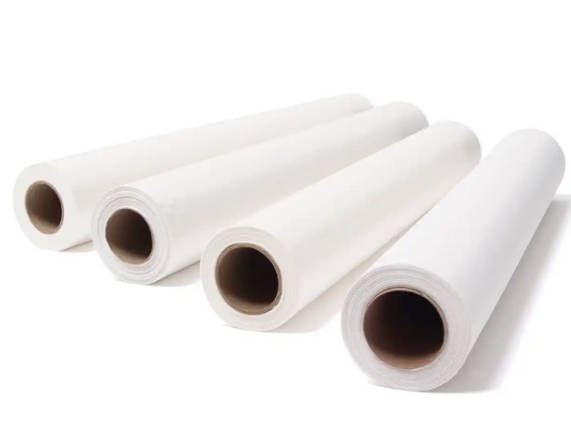
Product Samples We Regularly Subject to Thermal Sublimation Transfer Paper Mechanical Testing
We receive papers intended for all common sublimation printing processes. The following categories represent the most frequently tested items:
- Inkjet sublimation papers – quick-dry and slow-dry grades with a range of coating weights, from 80 g/m² to 180 g/m², for roll‑to‑roll and sheet‑fed printers
- Screen‑printing and offset sublimation papers – heavier, dimensionally stable grades for sheet‑fed litho and screen‑printing applications
- Tacky and non‑tacky transfer papers – papers with an adhesive coating to fix the fabric during pressing, and standard non‑tacky papers
- Coated base papers and raw base papers – both the uncoated cellulose substrate and the fully converted, coated product
- Jumbo rolls, slit rolls and cut sheets – finished product as delivered to the printer, tested in the machine direction and cross direction
- Aged and climate‑conditioned samples – papers that have been stored under defined humidity and temperature regimes to assess the effect of warehouse conditions on mechanical performance
Tensile Strength, Elongation and Tear Resistance – Primary Mechanical Parameters for Sublimation Papers
- Tensile strength and elongation at break according to ČSN EN ISO 1924-2 and ISO 1924-3: strips 15 mm wide are pulled in a constant‑rate‑of‑elongation tensile tester with a gauge length of 100 mm or 180 mm. The breaking force in newtons, the tensile strength in kN/m, the percentage elongation at break and the tensile energy absorption are measured in both the machine direction and the cross direction. For Czech printers, high machine-direction strength is essential to prevent web breaks during the high‑tension transfer of a wide‑format jumbo roll, while sufficient cross‑direction elongation assures the paper can wrap around the heated roller without cracking.
- Wet tensile strength after controlled water contact according to ČSN EN ISO 3781 and internal procedures: the specimen is wetted in a defined manner to simulate the contact with water‑based ink, and the residual tensile force is measured. The ratio of wet to dry tensile strength is reported, which is critical for inkjet sublimation papers that must survive printing without disintegrating under the wet ink film.
- Tear resistance (Elmendorf) according to ČSN EN ISO 1974: a stack of four sheets is torn with the Elmendorf pendulum tester, and the mean tearing force in millinewtons is measured in both directions. This test determines the edge‑tear resistance that protects the paper against initiation of a tear at a nicked edge or a perforation, a common failure mode when a roll is being loaded or when a sheet is mechanically fed.
- Internal bond strength (Scott bond) according to TAPPI T 569 and ISO 16260: the energy required to rapidly delaminate the paper in the Z‑direction is measured with a falling‑pendulum or tensile‑delamination instrument. A high internal bond strength is necessary to prevent the paper from splitting when the hot platen is opened and the transfer sheet is peeled away from the substrate.
Surface Strength, Coating Adhesion and Fuzz Resistance – Mechanical Integrity of the Coated Layer
- IGT pick velocity and surface bonding strength according to ČSN ISO 3783 and ISO 12634: the paper is printed with a tack‑graded oil or ink at an accelerating speed on an IGT printability tester. The velocity at which the coating begins to pick, blister or delaminate is recorded. For a sublimation paper, a high pick resistance proves that the coating will not lift during the inkjet printing or screen‑printing process and contaminate the press.
- Wax pick test for coating cohesion according to ČSN ISO 5632: a series of molten wax sticks of increasing adhesive power is applied to the coated surface and pulled away after cooling. The highest wax number that does not disturb the coating is reported. This classical test gives a rapid, comparative measure of the surface binding strength and is still requested by Czech converters.
- Taber abrasion and rub resistance of the coated surface: the coated side is subjected to a controlled number of rub cycles with a dry or slightly dampened cloth under a defined load. The loss of coating mass and the appearance of any loose fibre or coating dust on the rubbing cloth are reported. This thermal sublimation transfer paper mechanical testing service identifies papers that will generate excessive dust inside a printer or on the heat press and degrade the image quality.
- Blocking tendency and peel force between stacked sheets: coated sheets are placed face‑to‑back under a defined pressure, temperature and humidity for a specified time, and the force required to separate them is measured. A low blocking force is essential for high‑speed sheet feeding, and the test is performed both at room temperature and at the elevated temperature experienced in the feed tray of a press.
Stiffness, Handleability and Dimensional Stability – Mechanical Behaviour During Processing and Pressing
- Bending stiffness according to ČSN ISO 2493 and the two‑point method of ČSN ISO 5628: the bending resistance in millinewtons is measured in the machine direction and cross direction at a bending angle of 15° or 30°. Sufficient stiffness is required for the paper to self‑support in a flatbed printer or to be pulled from a roll without wrinkling, while excessive stiffness can cause the paper to lift away from the platen.
- Taber stiffness and bulk determination: the stiffness index is correlated with the caliper and the grammage, and the specific stiffness (stiffness per unit grammage) is calculated. Czech importers use these values to verify that the paper meets the specification for a given printer model and ink load.
- Dimensional stability under heat – thermal shrinkage and expansion according to a standardised heat‑press cycle: a precisely measured sheet is placed in a hot press at 200 °C for 60 seconds, then cooled and remeasured. The percentage change in length and width, and the out‑of‑plane distortion (curl) are reported. Minimal and symmetric shrinkage in both directions is the most important parameter for a sublimation paper because any differential movement during pressing will cause a double image or a blurred transfer on the textile or hard substrate.
- Curl and cockle after liquid water contact: a strip of paper is floated on water for a defined time, then laid flat to dry. The residual curl is measured as the height of the lifted edges. This test simulates the behaviour of a sublimation paper when it is heavily inked on one side and predicts whether it will lie flat on the substrate during pressing or whether it will roll up and cause a mis-transfer.
Mechanical Performance After Simulated Pressing and Transfer – Post‑Process Evaluation
- Peel force and transfer uniformity measurement: the paper is pressed onto a standard polyester fabric or a coated aluminium panel under controlled temperature, pressure and time. The force required to peel the paper from the substrate at a constant angle and speed is recorded, and any areas of coating residue left on the paper or un‑transferred ink are quantified by image analysis. This test directly correlates with the ease of removal of the transfer paper after pressing and the quality of the final printed product.
- Re‑use or re‑press resistance of the transfer paper: the paper is subjected to a second press cycle without re‑inking, and the residual ink transfer, the paper strength and the dimensional stability are remeasured. The results indicate whether the paper can be re‑used for a second, lighter transfer, a practice that some Czech textile decorators employ to reduce waste.
- Effect of ink load on mechanical properties: paper samples are printed with a standardised ink coverage from 20 % to 400 % of the maximum ink limit, then tested for tensile strength, stiffness and dimensional stability. The influence of the ink film on the mechanical behaviour is documented, allowing the printer to adjust the colour profile and the press settings to stay within the safe operating window of the paper.
- Fatigue resistance under repeated thermal cycling: a sheet is passed through a heat‑press simulation several times without ink transfer, and the drop in tensile strength, the increase in curling and any discolouration of the paper are measured. This thermal sublimation transfer paper mechanical testing service defines the maximum number of press cycles a paper can endure before it must be discarded, a parameter that is part of the cost‑of‑use calculation for Czech print shops.
Report Acceptance and Regulatory Compliance for the Czech Republic
All measurements performed within our thermal sublimation transfer paper mechanical testing service are executed under the fully accredited scope of our ISO/IEC 17025 quality management system. Each test report that carries the ILAC mark is therefore recognised automatically by the Czech Trade Inspection Authority, customs offices and all notified bodies in the European Union. For Czech importers, paper converters, printing houses and sublimation equipment suppliers, the report constitutes legally robust evidence that the transfer paper meets the mechanical and physical requirements declared by the manufacturer and required by the printing process. It can be directly used for supplier qualification, to support CE marking documentation, to provide objective data in warranty and performance disputes, and to demonstrate due diligence in the event of a product recall or a liability claim.