Pressure Resistant Blasting Test Service – Accredited Burst Strength and Containment Integrity Evaluation for the Czech Market
Our internationally accredited laboratory delivers a specialist pressure resistant blasting test service that provides Czech manufacturers, importers, pressure equipment fabricators and plant operators with the independent, traceable evidence required to verify the ultimate strength and failure behaviour of pressure‑containing components. Every test is conducted within the rigorous framework of ISO/IEC 17025, and each report bearing the ILAC mark is unconditionally accepted by the Czech Trade Inspection Authority, the Technical Inspection of the Czech Republic, customs offices and all notified bodies across the European Union. This pressure resistant blasting test service deliberately pressurises a vessel, pipe, hose or fitting with a liquid or gas until rupture occurs, recording the maximum pressure sustained, the deformation pattern and the fracture morphology. For a Czech boiler manufacturer, a hydraulic cylinder importer or a supplier of composite gas cylinders, the measured burst pressure is the definitive proof that the component possesses the safety margin required by the Pressure Equipment Directive 2014/68/EU, the Transportable Pressure Equipment Directive and the relevant harmonised product standards.
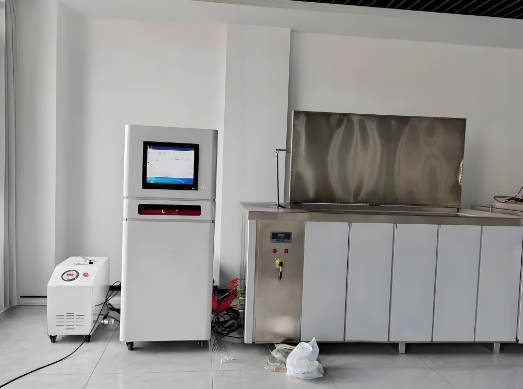
Product Samples We Regularly Subject to Pressure Resistant Blasting Tests
Our hydraulic and pneumatic test rigs can generate pressures exceeding 20 000 bar and accommodate specimens from miniature fittings to industrial‑scale vessels. The following categories represent the most frequently tested items:
- Pressure vessels and storage tanks – welded steel vessels, stainless steel reactors, air receivers, LPG tanks and water heaters
- Pipes, tubes and tubular assemblies – seamless and welded steel pipes, copper and aluminium tubes, plastic pressure pipes and multi-layer composite pipes
- Hydraulic and pneumatic hoses – rubber, thermoplastic and PTFE hose assemblies with end fittings for high‑pressure fluid power and chemical transfer
- Valves, fittings and flanges – ball valves, gate valves, check valves, pipe couplings, compression fittings and bolted flange connections
- Gas cylinders and composite overwrapped vessels – steel and aluminium cylinders for CNG, hydrogen, oxygen and breathing air, and fully wrapped composite cylinders
- Automotive and fuel system components – common‑rail injector pipes, brake hoses, fuel rails, airbag inflator housings and gas generator chambers
- Expansion joints, bellows and flexible connectors – metallic and rubber expansion joints for district heating, chemical plants and exhaust systems
- Pressure accessories and safety devices – pressure switches, transmitter housings, sight glasses and filter bowls
Metallic Pressure Vessels and Tanks – Pressure Resistant Blasting Test According to EN 13445-5 and ASME VIII
- Hydraulic burst test of welded pressure vessels according to ČSN EN 13445-5 and the Pressure Equipment Directive 2014/68/EU: the vessel is completely filled with water to eliminate the stored energy of compressed gas, and the pressure is raised at a controlled rate until rupture. The maximum pressure reached – the burst pressure – is recorded, and the location and morphology of the fracture are documented photographically. For a vessel designed to the code, the burst pressure must not be less than 2.25 to 3.5 times the maximum allowable working pressure, depending on the material and the design safety factor. Czech pressure vessel manufacturers use this pressure resistant blasting test service to validate their design calculations and to demonstrate the ultimate margin of safety for the type‑examination certificate.
- Burst test of air receivers and storage tanks according to the requirements of ČSN 690012 and customer specifications: the tank is subjected to a hydrostatic pressure ramp, and strain gauges or 3D optical deformation measurement track the strain distribution. The burst pressure and the deformation pattern are compared with the predictions of finite‑element analysis, and any discrepancy is investigated to refine the welding procedure or the material selection.
- Temperature‑corrected burst testing for vessels operating at elevated or cryogenic temperatures: the vessel is heated or cooled to its minimum or maximum design temperature before the burst test is initiated. For LPG tanks and cryogenic vessels, the test verifies that the ductile‑to‑brittle transition does not reduce the burst pressure below the code‑required minimum.
- Pneumatic proof‑and‑burst testing of small vessels and components where water filling is not feasible: for certain fuel‑system components and sealed electronic housings, a controlled pneumatic pressurisation with inert gas is applied until failure. The test is conducted inside a protective enclosure with ballistic shielding, and the burst pressure and fragment pattern are recorded.
- Creep‑to‑failure and sustained pressure testing: a vessel or fitting is held at a constant high pressure for up to 1 000 hours. The time to rupture is recorded, and the stress‑rupture curve is constructed, providing data on the long‑term behaviour of materials under sustained load, essential for Czech chemical reactor and hydrogen refuelling station components.
Pipes, Hoses and Fittings – Pressure Resistant Blasting Test for Fluid Conductors According to ISO 1402 and EN 13480
- Determination of the minimum burst pressure of hydraulic and process hoses according to ČSN EN ISO 1402 and SAE J343: the hose assembly is pressurised at a rate of 10 MPa/s to 50 MPa/s until failure. The burst pressure must be at least twice the working pressure for hydraulic hoses, and four times for thermoplastic hoses intended for high‑pressure water jetting. The location of the burst – in the hose body or at the end‑fitting – and the nature of the failure are recorded. Czech importers of hydraulic components rely on this test to verify conformity with the declared performance and to prevent premature failures in construction and agricultural machinery.
- Burst testing of rigid pipes according to ČSN EN 13480 and ASTM D1599: seamless and welded steel pipes, copper and aluminium tubes, and plastic pressure pipes are sealed at both ends and pressurised to failure. The burst pressure and the hoop‑stress at failure are calculated, and the result is compared with the specified minimum tensile strength of the pipe material. For plastic pipes, the test is performed at several temperatures to account for the temperature sensitivity of the polymer.
- Pneumatic burst test of small‑diameter tubes and capillary coils: for fine‑diameter stainless‑steel and alloy tubes used in instrumentation and chromatography, a pneumatic burst test with dry nitrogen is performed. The burst pressure, the fragment pattern and the leak‑before‑burst behaviour are evaluated, and the results are used by Czech manufacturers of analytical instruments and medical devices to certify the safety of their high‑pressure fluid paths.
- Burst test of pipe fittings, flanges and mechanical joints: a complete assembly of pipe, fitting and weld or brazed joint is pressurised to failure. The test verifies that the joint is not the weakest point in the system and that the failure occurs in the pipe body, not in the connection. For Czech district heating and gas distribution networks, this is a mandatory requirement for the approval of new jointing systems.
- Fatigue‑to‑burst assessment after pressure cycling: the component is first subjected to a defined number of pressure cycles at a lower pressure, then the residual burst pressure is measured. The reduction in burst strength quantifies the accumulated fatigue damage and is used to set safe replacement intervals for hydraulic hammers and pulsating process lines.
Composite Cylinders, Plastic‑Lined Vessels and Gas Storage – Pressure Resistant Blasting Test According to EN 12245 and ISO 11515
- Hydraulic burst test of fully wrapped composite cylinders according to ČSN EN 12245: a cylinder with a metal or polymer liner and a carbon‑fibre or glass‑fibre overwrap is filled with water and pressurised until burst. The burst pressure, the mode of failure – liner rupture, fibre breakage or boss detachment – and the fragmentation behaviour are recorded. The cylinder must burst at a pressure well above the test pressure and must not shatter into dangerous fragments. This pressure resistant blasting test service is the cornerstone of the type‑approval procedure for CNG and hydrogen cylinders used in Czech buses and passenger cars.
- Pneumatic explosion‑impulse testing of hydrogen cylinders according to ISO 11515 and EU Regulation 406/2010: the cylinder is subjected to a rapid pressure pulse with a defined rise time, simulating a thermal‑runaway event or an internal deflagration. The dynamic burst pressure and the fragment pattern are evaluated against the safe fragmentation limits, and the data are submitted to the notified body for the approval of hydrogen‑powered vehicles.
- Burst test of plastic‑lined pressure vessels and accumulator shells: the vessel is pressurised at its maximum and minimum design temperatures to capture the effect of temperature on the ductility of the polymer liner. The burst pressure must not fall below the code‑required minimum even at the cold extreme of -40 °C, a condition experienced by Czech outdoor machinery during winter.
- Burst performance of repaired and requalified cylinders: cylinders that have been in service and are presented for periodic inspection are sampled and subjected to a burst test to verify that the material properties have not degraded. The results are used by Czech cylinder testing stations to validate their acceptance criteria for continued service.
Report Acceptance and Regulatory Compliance for the Czech Republic
All tests performed within our pressure resistant blasting test service are executed under the fully accredited scope of our ISO/IEC 17025 quality management system. Each test report that carries the ILAC mark is therefore automatically recognised by the Czech Trade Inspection Authority, the Technical Inspection of the Czech Republic, customs offices and all notified bodies in the European Union. For Czech pressure equipment manufacturers, cylinder importers, hydraulic system suppliers and plant operators, the report constitutes legally robust evidence that the component possesses the required ultimate strength and fails in a safe, predictable manner. The documentation can be directly used to support CE marking under the Pressure Equipment Directive, to issue inspection certificates according to ČSN EN 10204, to obtain type‑approval certificates for transportable pressure equipment, and to resolve commercial and technical disputes concerning the integrity of pressure‑containing products.