Dust Emission Testing Service – Accredited Isokinetic and Gravimetric Measurement for Clean Air Compliance on the Czech Market
Our internationally accredited laboratory provides a dedicated dust emission testing service that generates the legally defensible emission data Czech plant operators, filter manufacturers, building product suppliers and equipment importers require to demonstrate compliance with EU and national air quality regulations. All tests are conducted within the strict framework of ISO/IEC 17025, and every report bearing the ILAC mark is unconditionally accepted by the Czech Trade Inspection Authority, the Czech Environmental Inspectorate, customs offices and all notified bodies across the European Union. From isokinetic sampling in industrial stacks to the characterisation of dust release from construction materials in a controlled chamber, our dust emission testing service quantifies the mass concentration, particle size distribution, emission rate and filter efficiency that determine whether a process, product or plant satisfies the emission limit values of the Industrial Emissions Directive, the Medium Combustion Plant Directive and the Czech Clean Air Act.
Product Samples and Emission Sources We Regularly Subject to Dust Emission Testing
The measurement equipment deployed in the field and in the laboratory covers a vast range of sources and materials. The following categories represent the most frequently tested items and emission points:
- Industrial stacks and chimneys – point sources from power plants, cement kilns, foundries, incinerators and biomass boilers
- Baghouse filters, cartridge filters and electrostatic precipitators – complete dedusting units and individual filter elements evaluated for outlet dust concentration and filtration efficiency
- Construction products and building materials – bulk powders, fillers, leveling compounds, dry mortar mixes and aggregates
- Vacuum cleaners and power tools – household, commercial and industrial vacuum cleaners, angle grinders, concrete saws and sanders
- Vehicle brake systems and tyre wear simulators – brake pads, discs and tyre specimens for the quantification of non-exhaust particulate emissions
- Road sweepers and municipal cleaning vehicles – complete vehicles and their suction systems
- Cleanrooms and controlled environments – airborne particle concentrations according to the ISO 14644 series
Dust Emission Testing Service for Industrial Stacks and Stationary Sources – EN 13284, ISO 9096 and CEN/TS Methods
- Determination of low-range dust concentration by isokinetic sampling according to ČSN EN 13284-1: a representative sample is extracted from the gas stream at a velocity equal to the local gas velocity using an isokinetic probe. The dust collected on a pre-weighed planar filter is dried and weighed, and the concentration in mg/Nm³ is calculated. This method is the reference technique for stacks with concentrations below 50 mg/Nm³ and is mandatory for demonstrating compliance with emission limit values in the Czech Republic.
- Measurement of dust mass flow and total emission according to ČSN EN 13284-2 and ISO 9096: for higher dust loads or for the periodic monitoring of cement plants and foundries, the gravimetric determination is combined with a measurement of the gas velocity, temperature and water vapour content. The total dust mass flow in kg/h is reported, and the result is compared with the permitted emission cap in the integrated permit issued by the Czech regional authority.
- Particle size distribution in stack emissions by cascade impactor according to ČSN EN ISO 23210: a low-pressure cascade impactor is inserted into the stack to separate the dust into aerodynamic diameter fractions. The mass of each fraction is determined, and the size-selective emission is expressed as PM10, PM2.5 and PM1 fractions. This dust emission testing service provides the data required for health impact assessments and for the selection of the correct filtration technology.
- Continuous dust monitoring validation according to ČSN EN 14181: the installed continuous emission monitoring system is calibrated against the standard reference method in a multi-point correlation test. The linearity, the response to zero and span gases and the cross-sensitivity to water vapour are verified, and a quality assurance level report is issued for submission to the Czech Environmental Inspectorate.
Dust Emission Testing Service for Filter Systems, Dedusters and Industrial Ventilation – ISO 16890, EN 1822 and ISO 29461
- Fractional filtration efficiency of general ventilation filters according to ČSN EN ISO 16890: a test aerosol of DEHS or KCl is introduced upstream of the filter, and the particle concentration downstream is measured with an optical particle counter in the size range 0.3–10 µm. The filter is classified as ePM1, ePM2.5, ePM10 or coarse, and the minimum efficiency at the relevant particle size is reported. Czech HVAC specifiers use this classification to select filters that meet the outdoor air quality requirements for buildings in Prague and Brno.
- High-efficiency particulate air and ultra-low penetration air filter testing according to ČSN EN 1822: the filter is scanned with a monodisperse aerosol of the most penetrating particle size, and the local penetration is measured. The filter is classified as H13, H14, U15, U16 or U17. This test is mandatory for terminal filters in pharmaceutical cleanrooms and hospital operating theatres, and our report is accepted by the Czech State Institute for Drug Control.
- Dust emission and efficiency of baghouse and cartridge filters according to ISO 29461 and VDI 3926: a pulse-jet cleaned filter unit is loaded with a standardised test dust, and the dust concentration in the cleaned gas is measured gravimetrically after each cleaning cycle. The residual pressure drop, the cleaning interval and the emission concentration in mg/m³ are recorded for a minimum of 1 000 hours, providing the data that Czech industrial buyers use to compare filter media and to size the filter housing.
- Leak detection and filter integrity testing: a fluorescent or oil aerosol is generated upstream, and a photometer or optical particle counter scans the entire face area of the filter and its mounting frame. Any leak exceeding 0.01 % of the upstream concentration is pinpointed and repaired, and the test report certifies the installation for cleanroom operation according to the ISO 14644 series.
Dust Emission Testing of Construction Products and Bulk Materials – EN 15051 and Düsseldorf Methods
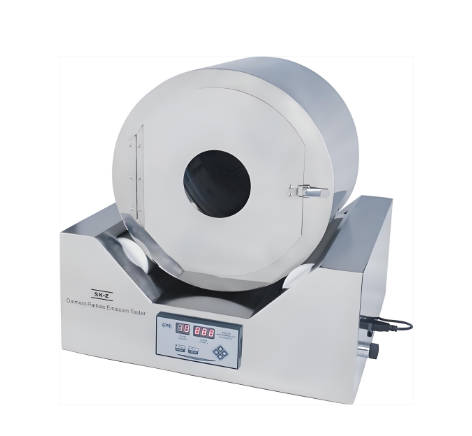
- Respirable and inhalable dustiness of bulk materials according to ČSN EN 15051-1 (continuous drop method) and ČSN EN 15051-2 (rotating drum): a defined mass of powder, granulate or dry mortar is dropped in a controlled airflow or rotated in a drum, and the generated dust is collected on a foam or filter substrate. The respirable fraction and the inhalable fraction in mg/kg are reported. For Czech producers of tile adhesives, grouts and self-leveling compounds, this test is the basis for the exposure scenario in the safety data sheet.
- Dust emission from building material during cutting and abrasion: concrete blocks, aerated concrete panels and fibre-cement boards are cut with a power saw inside a test enclosure, and the aerosolised dust concentration is measured gravimetrically and by an optical particle counter. The emission rate per metre of cut is calculated and used by Czech construction firms to select low-dust materials and to specify the required respiratory protection.
- Release of hazardous substances from construction products under realistic use: for products containing crystalline silica, heavy metals or fibres, the dust generated during sanding, drilling or demolition is collected and analysed chemically. The emission of respirable crystalline silica in µg/m³ is determined and checked against the occupational exposure limit value adopted in the Czech Republic. This data supports the declaration of performance under the Construction Products Regulation.
Vacuum Cleaners, Power Tools and Domestic Appliances – Dust Emission Testing for Consumer and Workplace Safety
- Dust re-emission and filtration efficiency of vacuum cleaners according to ČSN EN 60312-1 and IEC 62885-2: the vacuum cleaner is operated on a standardised test carpet with a defined loading of IEC 60312 test dust. The dust concentration in the exhaust air is measured with a particle counter in the range 0.3–10 µm, and the dust re-emission class from A to G is assigned. For Czech importers of household and wet-dry vacuum cleaners, this classification is mandatory for the energy label and the product fiche.
- Dust emission of electric power tools during sanding, grinding and cutting according to the EN 50632 series and IEC 62841: the tool is operated in a test tunnel, and the respirable dust concentration at the operator position is measured gravimetrically. The dust collection efficiency of the integrated or attached dust extraction system is calculated. For angle grinders, concrete saws and orbital sanders sold on the Czech market, this test verifies compliance with the exposure limit values set by the Czech Labour Code.
- Whole-appliance dust emission for robotic and cordless stick vacuum cleaners: the unit is tested in a sealed chamber with a full duty cycle, and the total emitted particulate mass is collected on a filter. The emission in mg per cleaning cycle is reported, and the result is used by Czech retailers to substantiate marketing claims concerning allergy-friendly and asthma-suitable products.
Non-Exhaust Vehicle Emissions – Dust Emission Testing of Brake and Tyre Wear Particles
- Brake wear particle emission measurement according to the UN GTR 24 and JASO C470: a brake assembly is mounted on a dynamometer, and a defined braking cycle is run while the cooling air is filtered and the emitted particles are counted and collected. The particle number emission in particles/km and the mass emission in mg/km are determined for PM10 and PM2.5 fractions. This dust emission testing service supports Czech automotive suppliers in preparing for the Euro 7 emission standards, which will regulate brake wear particles for the first time.
- Tyre wear particle emission from rolling resistance and abrasion rigs: a tyre is rolled on a drum or a belt with a simulated road surface, and the abraded particles are sampled isokinetically. The mass and size distribution of the tyre wear particles are reported, and the effect of the rubber formulation and the road texture is investigated. The data are used by research consortia and tyre importers to develop low-emission products for the Czech and EU markets.
- Resuspension of road dust from vehicle passages: a test vehicle is driven through a controlled dust layer, and the airborne dust plume is measured with an array of optical particle counters. The resuspension factor is calculated, providing input for air quality modelling in Czech cities and for the assessment of street sweeping programmes.
Report Acceptance and Regulatory Compliance for the Czech Republic
All measurements performed within our dust emission testing service are executed under the fully accredited scope of our ISO/IEC 17025 quality management system. Each test report that carries the ILAC mark is therefore recognised automatically by the Czech Trade Inspection Authority, the Czech Environmental Inspectorate, regional building authorities and all notified bodies in the European Union. For Czech plant operators, filter manufacturers, construction product suppliers and equipment importers, the report constitutes legally robust evidence that the dust emissions comply with the applicable emission limit values, product standards and occupational health regulations. The documentation can be directly used for integrated permitting, for CE marking under the Construction Products Regulation, for energy labelling and ecodesign compliance, and for demonstrating due diligence in environmental liability claims.