Fishtail Board (Fishplate) Test – Accredited Mechanical and Metallurgical Testing for Czech Railway Infrastructure
Our internationally accredited laboratory delivers comprehensive fishtail board test services, providing the precise, independent data that Czech railway operators, track constructors and rolling stock manufacturers need to verify the safety and durability of rail joint bars. All tests are performed within our rigid ISO/IEC 17025 quality system, and every report bearing the ILAC mark is unconditionally accepted by the Czech Trade Inspection Authority, the Drážní úřad (Czech Railway Authority) and all notified bodies across the European Union. A fishtail board, or fishplate, is the bolted connector that joins two rail ends, and its mechanical integrity is fundamental to track safety, ride quality and the prevention of derailments. Our fishtail board test programme covers tensile strength, hardness, microstructural soundness, dimensional accuracy and bolt-hole integrity, fully aligned with the requirements of ČSN EN 13674-2 and the technical specifications for interoperability of the Czech national railway network.
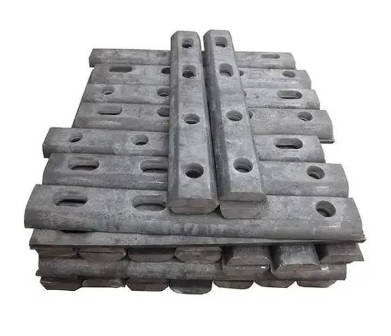
Product Samples We Regularly Subject to the Fishtail Board Test
We receive fishtail boards intended for all categories of track, from light industrial sidings to high-speed passenger corridors. The following types represent the most frequently tested items:
- Standard steel fishtail boards for Vignole rails – four-bolt and six-bolt configurations in grades 4.6, 5.6 and 8.8 according to ČSN EN 13674-2
- Joggled and cranked fishtail boards – special profiles for transition joints between different rail sections and for insulated block joints
- Heat-treated and microalloyed fishtail boards – enhanced-strength grades for heavy-haul freight corridors and high-speed lines in the Czech Republic
- Fishtail boards with corrosion-protection coatings – hot-dip galvanized, sherardized and organic-coated fishplates for tunnels, coastal and humid environments
- Repaired or reclaimed fishtail boards – items taken from track for residual-life assessment or after weld repair
- Fishtail board assemblies with bolts, nuts and washers – complete joint kits where the combined performance of the fishplate and fasteners is evaluated
Mechanical Strength and Ductility – Fishtail Board Test According to ČSN EN 13674-2 and ČSN EN ISO 6892-1
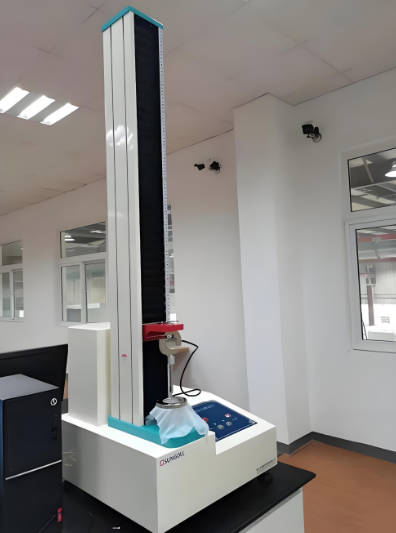
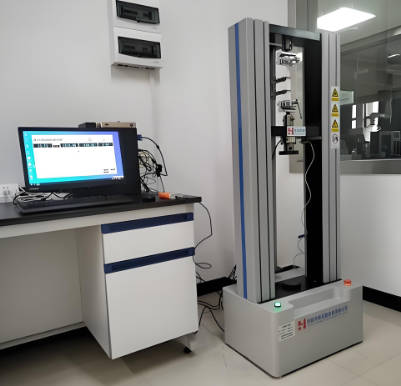
- Tensile test on the fishplate material according to ČSN EN 13674-2 and ČSN EN ISO 6892-1: a full-thickness flat tensile specimen is machined from the web or flange of the fishtail board. The specimen is pulled to fracture at a controlled strain rate, and the yield strength (ReH or Rp0.2), ultimate tensile strength (Rm), and percentage elongation after fracture (A) are recorded. For a grade 5.6 fishplate, the minimum tensile strength is 500 MPa and the minimum elongation is 15 %. Our fishtail board test verifies these values and reports the complete stress-strain curve for the material.
- Bend test for ductility assessment according to ČSN EN ISO 7438: a rectangular specimen cut transversely from the fishplate is bent over a mandrel of specified diameter to an angle of 180°. The absence of cracks or other discontinuities on the tension surface demonstrates that the steel has sufficient cold formability to accommodate the small bending stresses at the rail joint without brittle fracture.
- Brinell hardness test according to ČSN EN ISO 6506-1: the hardness of the fishplate steel is measured at multiple locations, including the bolt-hole region where contact stresses from the bolts are highest. The hardness is reported in HBW and checked against the maximum values permitted by the standard for the declared grade, ensuring that the material is neither too soft to resist wear nor too hard to risk cracking under dynamic loading.
- Shear test on the bolt-hole bearing area: a bolt of the correct grade is installed in the fishplate hole, and a shear load is applied until failure or a specified deformation is reached. The bearing stress at which the hole elongates by a critical amount is reported, providing data for the Czech track designer to verify that the joint will not loosen prematurely under traffic loads.
Dimensional, Visual and Non-Destructive Inspection in the Fishtail Board Test
- Dimensional verification of fishplate geometry according to ČSN EN 13674-2: the overall length, width, thickness at the web and flange, bolt-hole diameter, and hole pitch are measured with calibrated callipers, micrometers and a coordinate measuring machine. Every dimension is compared with the manufacturer's drawing and the tolerances given in the standard, because a misfit at the joint can impose dangerous bending moments on the rail ends.
- Straightness and twist measurement: the fishplate is placed on a surface plate, and any deviation from flatness or twist is measured with feeler gauges and a dial indicator. Excessive distortion could cause the fishplate to spring the rail ends out of alignment, affecting the running surface and passenger comfort on Czech trains.
- Visual inspection and magnetic particle testing for surface defects: the entire fishplate surface, especially the bolt holes and the bearing faces, is examined under good lighting. Magnetic particle inspection according to ČSN EN ISO 17638 is then performed to detect any surface-breaking cracks, laps or seams that could initiate fatigue fracture in service.
- Ultrasonic testing for internal discontinuities: the fishplate body and the highly stressed regions around the bolt holes are scanned with an ultrasonic flaw detector according to ČSN EN ISO 16810. Any internal laminations, inclusions or shrinkage cavities that exceed the acceptance limit are documented, and the fishplate is rejected or graded for less critical applications.
Report Acceptance and Regulatory Compliance for the Czech Republic
All fishtail board tests described above are performed within the fully accredited scope of our ISO/IEC 17025 quality management system. Each test report that carries the ILAC mark is therefore recognised automatically by the Czech Trade Inspection Authority, the Drážní úřad, and all notified railway inspection bodies in the European Union. For Czech railway infrastructure contractors, maintenance depots and importers of track components, the test report constitutes legally robust evidence that the fishtail boards conform to ČSN EN 13674-2 and the relevant Technical Specifications for Interoperability. The documentation can be directly used to issue inspection certificates according to ČSN EN 10204, to support the certification of railway products, and to provide an indisputable basis in warranty claims or incident investigations concerning rail joint performance.