Moisture Wicking Test – Accredited Measurement of Liquid Moisture Transport in Textiles for the Czech Market
Our moisture wicking test services provide manufacturers and importers with the precise, fully documented data needed to evaluate and substantiate the sweat-management claims of their performance fabrics. All tests are conducted under our rigid ISO/IEC 17025 accreditation, and every report bearing the ILAC mark is automatically accepted by the Czech Trade Inspection Authority, customs offices and notified bodies across the European Union. For Czech sportswear brands, workwear suppliers and medical textile converters, an independent moisture wicking test quantifies the speed and distance that liquid moisture travels through a fabric, the pattern of its spread, and the rate at which the fabric then dries. These parameters are decisive for comfort, thermoregulation and performance, and our reports serve as legally robust proof for consumer labelling, public procurement tenders and CE-marking documentation.
Product Samples We Regularly Subject to Moisture Wicking Tests
We receive a broad variety of textile materials and finished products that rely on efficient liquid sweat transport. The most frequently tested categories are:
- Sportswear and activewear fabrics – knitted polyester, nylon-elastane blends and polypropylene base layers intended for running, cycling and gym use
- Underwear and intimate apparel – cotton, microfibre and seamless garments where skin-contact moisture must be moved away rapidly
- Socks and hosiery – walking, skiing and casual socks in which foot moisture management is linked to blister prevention
- Towels, bathrobes and beachwear – cotton and microfibre towelling fabrics valued for quick absorption and fast drying
- Medical textiles and wound dressings – nonwoven wound contact layers, absorbent pads and compression bandages where directional fluid transport is essential
- Outdoor and workwear fabrics – multi-layer laminated membranes, uniform shirting and protective clothing used by Czech fire and rescue services
- Nonwoven wipes and hygiene products – cleaning cloths, cosmetic wipes and disposable absorbent pads
Vertical Moisture Wicking Test – Wicking Height and Speed According to AATCC 197 and Comparable Methods
- Vertical wicking against gravity according to AATCC 197 and DIN 53924: a vertically suspended strip of fabric is immersed in distilled water to a depth of a few millimetres at its lower end. Capillary forces draw the water upwards, and the height reached by the moisture front is recorded at defined intervals – commonly 1, 5, 10 and 30 minutes. The result is the wicking height in millimetres and the wicking rate in millimetres per second. For the Czech workwear sector, high vertical wicking is a key performance parameter for shirts and jackets worn during physical labour.
- Wicking distance in warp and weft directions: specimens are cut and tested in both the longitudinal and transverse directions to identify anisotropic moisture transport. This is especially important for woven shirting fabrics where yarn density and weave structure create directional differences that affect how quickly sweat spreads across the garment.
- Wicking under controlled humidity and temperature: the test chamber is conditioned at 23 °C and 50 % relative humidity as required by the standard, ensuring comparability of results between fabric batches. For Czech importers, this guarantees that the measured performance will translate into real comfort in the temperate Central European climate.
Horizontal Wicking and Spread Rate – Moisture Wicking Test for Nonwoven and Wound Care Products
- Horizontal wicking by the drop-spot method according to AATCC 198 and ISO 9073-6: a defined volume of water is dispensed onto the surface of a fabric, and the advancing moisture front is timed and photographed. The maximum wetted diameter and the area of spread after a fixed time are calculated. For nonwoven wound dressings and cosmetic wipes sold on the Czech pharmacy market, this test demonstrates the lateral spreading capacity that ensures even absorption over the whole product surface.
- Capillary penetration and strike-through time for absorbent hygiene products: the time required for a liquid to fully penetrate the nonwoven topsheet and become available to the absorbent core is measured using an automated strikethrough plate. The values are reported in seconds and are a critical quality parameter for Czech suppliers of disposable diapers and incontinence pads.
- Reservoir capacity and liquid holding ability: after horizontal wicking has ceased, the saturated fabric is weighed to determine the maximum water retention per unit area. This parameter, combined with the spread rate, gives a complete picture of the product's overall moisture management capacity.
Dynamic Moisture Management Test – Comprehensive Moisture Wicking Test Using the MMT Apparatus
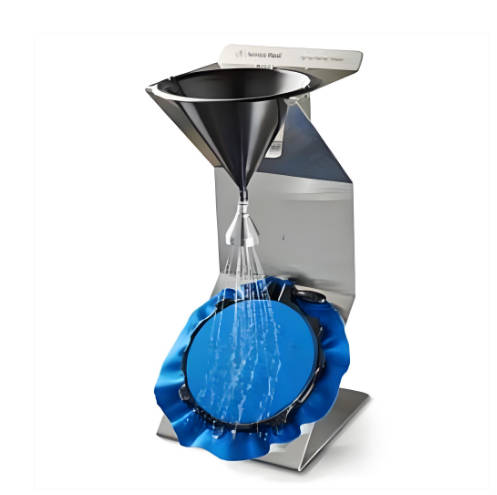
- Multidirectional liquid transport according to AATCC 195: the fabric specimen is placed horizontally between an upper and a lower electrical sensor ring, and a synthetic sweat solution is delivered to the top surface. The instrument continuously records the change in electrical resistance as the liquid spreads in all directions and transfers through the thickness. Ten indices are calculated, including wetting time for the top and bottom surfaces, top and bottom absorption rate, maximum wetted radius, top and bottom spreading speed, accumulative one-way transport index, and the overall moisture management capacity. This moisture wicking test is the definitive method for fabrics described as “quick-dry”, “breathable” or “moisture-wicking” on the Czech consumer market.
- One-way transport capability (OWTI): a positive OWTI value indicates that liquid is actively moved from the skin-contact side to the outer face of the fabric, where it can evaporate. For Czech manufacturers of sports base layers, a high OWTI is the most convincing proof that the garment will keep the wearer dry during prolonged exercise.
- Fingerprint grading of moisture management: the test classifies the fabric on a scale from Grade 1 (poor) to Grade 5 (excellent) for each index. The complete moisture management profile is presented in a single radar chart, enabling an immediate, intuitive comparison between competing fabrics and supporting straightforward marketing claims.
Drying Rate and Evaporative Cooling – Complementary Assessment to Moisture Wicking Test
- Drying rate measurement according to AATCC 200: a specific volume of water is applied to the fabric, and the specimen is placed on a heated plate set at 37 °C to simulate body temperature. The time required for the water to completely evaporate is recorded, and the drying rate is reported in millilitres per hour. This test is frequently combined with the moisture wicking test to provide a complete picture of thermophysiological comfort, and it is regularly requested by Czech suppliers of running apparel.
- Moisture vapour resistance under steady-state conditions according to ČSN EN ISO 11092 (sweating guarded hotplate): although primarily a vapour-permeability test, the instrument can measure the cooling power demand after wetting the fabric, indirectly quantifying the evaporative cooling effect. This is important for Czech producers of uniforms and protective clothing who must balance breathability with wind and water resistance.
- Cycle testing after repeated washing: to verify that the moisture management properties are durable, fabrics undergo a specified number of domestic laundering cycles according to ČSN EN ISO 6330 before the wicking or drying test is repeated. For Czech consumer goods, this is essential evidence that the “quick-dry” performance will last for the practical lifetime of the product.
Report Acceptance and Regulatory Compliance for the Czech Republic
All moisture wicking tests described above are executed within the fully accredited scope of our ISO/IEC 17025 quality management system. Each test report displaying the ILAC mark is therefore recognised automatically by the Czech Trade Inspection Authority, customs authorities and all notified bodies in the European Union. For textile mills, garment brands and medical device manufacturers, these reports provide legally robust evidence that the moisture management claims printed on hangtags and product data sheets are founded on impartial, repeatable measurements. The documentation can be directly used for supplier qualification, for CE marking of personal protective equipment, for inclusion in technical files for medical devices, and as a reliable defence in consumer complaints or trade disputes on the Czech market.