Wet Sand Rubber Wheel Wear Test – Accredited Abrasion Testing for Slurry-Exposed Materials on the Czech Market
Our internationally accredited laboratory delivers the wet sand rubber wheel wear test as a core service for evaluating the abrasion resistance of materials destined for the mining, dredging, agricultural and construction sectors. All testing is performed under the strict regime of ISO/IEC 17025, and every report carries the ILAC mark, guaranteeing unconditional acceptance by the Czech Trade Inspection Authority, customs offices and engineering inspection bodies across the European Union. The test faithfully reproduces low-stress sliding abrasion in a wet, sandy slurry – exactly the conditions faced by pumps, pipelines, chutes and ground-engaging tools operating in the Czech Republic and Central Europe. By generating repeatable volume loss data, we enable importers, manufacturers and procurement managers to compare wear-resistant steels, hardfacings, cast irons and ceramics on a fully independent basis.
Product Samples We Regularly Subject to the Wet Sand Rubber Wheel Wear Test
A wide variety of materials and wear components are machined into flat test coupons and evaluated in our slurry abrasion rigs. Typical samples include:
- Wear-resistant steel plates and sheets – quenched and tempered grades, duplex steels and cladded plates used for dump truck bodies, excavator buckets and conveyor liners
- Hardfacing overlays and weld deposits – chromium carbide, tungsten carbide and complex carbide overlays applied to agricultural tines, mixer blades and crusher hammers
- White cast irons and high-chromium irons – materials for slurry pump impellers, volutes, wear rings and classifier shoes
- Ceramics and cermets – alumina, silicon carbide, tungsten carbide and composite tiles for pipe linings, cyclones and chute liners
- Polymeric and elastomeric materials – polyurethane sheets, rubber linings and composite wear pads for screen decks and hydrocyclones
- Thermal spray coatings – HVOF-sprayed tungsten carbide, chromium oxide and nickel-based coatings on shafts, sleeves and hydraulic rods
- Additively manufactured wear parts – laser-clad and 3D-printed components with embedded hard phases for prototype tooling and repair applications
Wet Sand Rubber Wheel Abrasion Testing According to ASTM G105
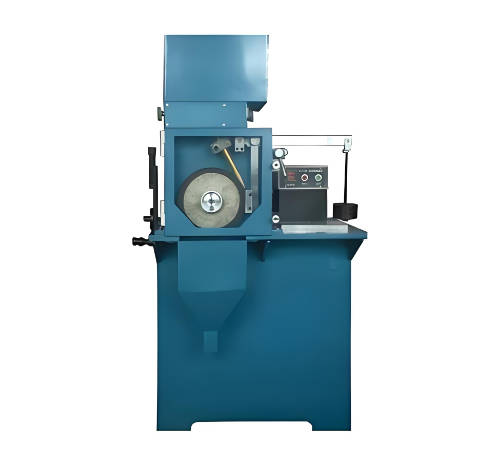
- Standard test method in full compliance with ASTM G105-20: a flat rectangular test specimen is pressed against the rim of a rotating rubber wheel with a defined normal force of 222 N (50 lbf). A slurry consisting of 50/70 mesh rounded quartz sand and deionized water is continuously dripped into the contact zone between the wheel and the specimen. The rubber wheel, with a diameter of 228.6 mm and a Shore A hardness of 60, rotates at 200 revolutions per minute, dragging the abrasive slurry across the specimen surface and producing low-stress scratching abrasion.
- Controlled sliding distance and wear measurement: the standard sliding distance is set to 1 436 metres, corresponding to 6 000 wheel revolutions. After the test, the specimen is thoroughly cleaned, dried and weighed on an analytical balance with a resolution of 0.1 mg. The mass loss is converted to volume loss in cubic millimetres using the density of the material, determined by the Archimedes method or helium pycnometry. The volume loss is the primary result reported and is directly proportional to the material's wear rate under wet slurry conditions.
- Sand specification and slurry consistency: the silica sand used is strictly graded to AFS 50/70 and is checked for particle size distribution by sieving before each campaign. The sand-to-water ratio is maintained at a constant 1.5 kg of sand per litre of water, and the slurry is agitated continuously to prevent settling. This rigorous control ensures interlaboratory repeatability and allows direct comparison of wear data with values published by material suppliers.
- Rubber wheel conditioning and replacement criteria: the rubber wheel is dressed with a diamond tool before each test to ensure a fresh, uniform surface and is replaced when the Shore A hardness deviates by more than 5 points or visible degradation occurs. The wheel material is verified for compliance with ASTM G105 specifications, and the rotation speed is monitored by a calibrated tachometer.
- Extended and modified test programmes for specific industries: while the ASTM G105 procedure defines the standard parameters, we also run extended sliding distances up to 12 000 revolutions for highly wear-resistant ceramics and cermets, and we can substitute the standard quartz sand with locally sourced Czech sand or industrial slurries upon customer request, enabling direct correlation with field wear in domestic operations.
Volume Loss Evaluation and Comprehensive Wear Reporting
- Precise determination of volume loss and relative wear resistance: the volume loss in mm³ is calculated from the measured mass loss and material density. For comparative evaluations, a reference material such as a mild steel plate is tested under identical conditions, and the relative wear resistance is expressed as the ratio of the reference volume loss to the test material volume loss. This dimensionless number is immediately understood by design engineers and maintenance planners.
- Surface analysis and wear scar characterisation: after the test, the worn surface is documented by macro photography and, if requested, examined by optical or scanning electron microscopy. The width and depth of the wear scar are measured with a profilometer, and the predominant wear mechanisms – microcutting, microploughing or pull-out of hard phases – are identified and reported. This microstructural insight helps material developers optimise carbide volume fraction, matrix toughness and grain size.
- Statistical treatment and quality assurance: each material is tested a minimum of three times to establish a mean volume loss and standard deviation. Control charts for the reference material are maintained to verify the long-term stability of the test rig, and all balances, density kits and micrometers are calibrated with traceability to national standards.
Complementary Abrasion Tests and Correlative Studies for the Czech Market
- Dry sand rubber wheel test according to ASTM G65: for materials that experience predominantly dry, sandy abrasion, the dry sand rubber wheel test is performed. The results are often compared with the wet test to determine the sensitivity of the material to the presence of water, which can alter wear rates through corrosion-enhanced abrasion or lubrication effects.
- Slurry erosion and impingement tests: for pump impellers and pipe bends subjected to high-velocity slurry impact, we offer slurry jet erosion tests according to ASTM G73, which complement the wet sand rubber wheel data and provide a complete picture of a material's performance in fluid handling systems.
- Correlation with field service data: upon request, we assist Czech mining and construction companies in building correlations between laboratory volume loss and actual service life in specific applications such as sand and gravel washing, brown coal mining and sewage sludge handling, enabling predictive maintenance scheduling and cost-per-tonne calculations.
Report Acceptance and Regulatory Compliance in the Czech Republic
All wet sand rubber wheel wear tests are performed entirely within the scope of our ISO/IEC 17025 accreditation. Each report displaying the ILAC mark is therefore automatically recognised by the Czech Trade Inspection Authority, technical inspection bodies and all notified organisations in the European Union. For Czech importers, steel stockholders and equipment manufacturers, the test report provides a legally sound, independent proof of abrasion resistance. It is accepted as a valid document for supplier qualification, for verifying compliance with performance specifications in tender documents, and for resolving warranty claims related to premature wear of ground-engaging and slurry-handling components.